

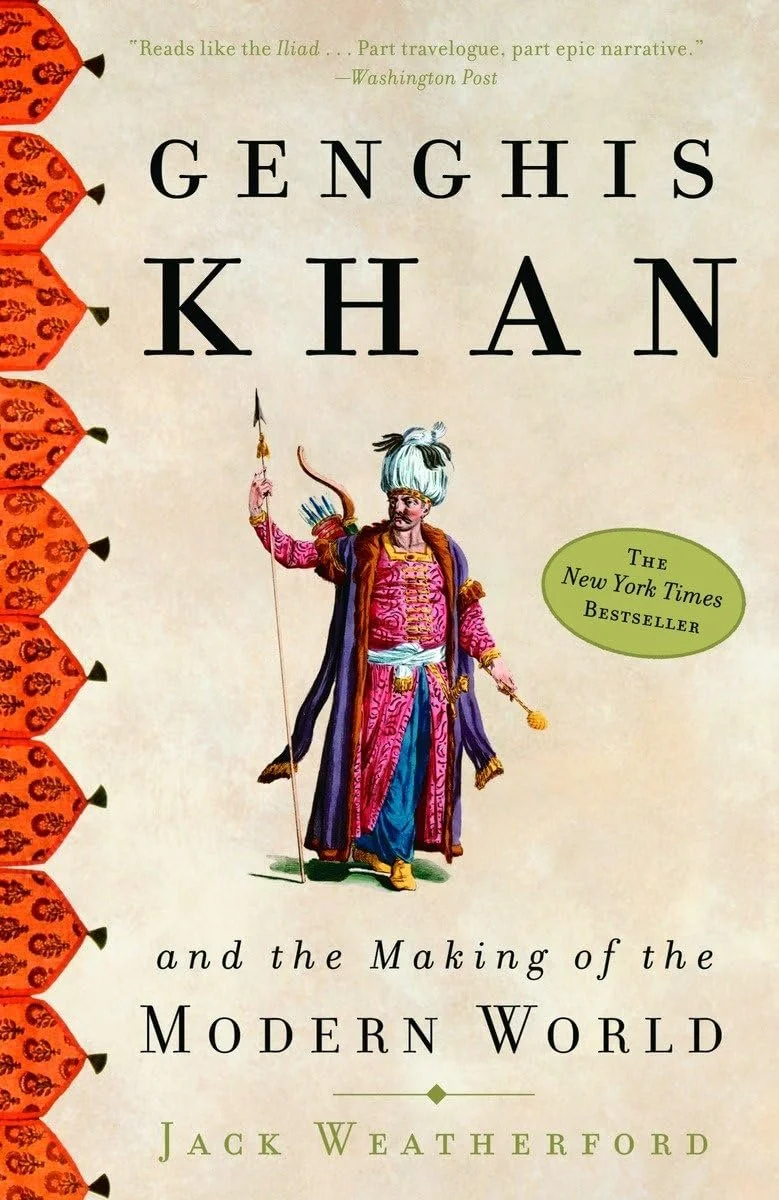
GENGHIS KHAN AND THE MAKING OF THE MODERN WORLD by Jack Weatherford
Rating: 8.75/10 reps
Categories: Society & History
If you liked Succession and Game of Thrones but felt they were a little too simplistic or soft… man, do we have a book for you. Bonus points if you’re into throat singing.
Author Jack Weatherford explores the origins of everything from the word Kamikaze and Assassin to the Black Plague and the Asian influence on European art and culture. What surprised people—other than the sheer scale of the violence during the expansion of the Mongol Empire—was the civility that existed right alongside that brutality. We’re talking about ramps made out of dead bodies so massive they were used to transport entire armies over city walls, and mass graves so large they literally created new swamps. Yet, these same Mongols paved the way for modern research centers, international passports, pluralistic societies, religious tolerance on a scale never seen before, paper money, and long-distance mail systems.
It’s hard not to marvel at how shocking it is for a random nomad in the Central Asian steppe to rise to power and build the largest contiguous land empire in history in a single lifetime. Even while acknowledging the horrifying scale of the violence, there is a surprising amount of compassion and raw humanity found in the stories of the ancient Mongol Empire.
The book gets overly dense in some parts, specifically when it starts rapid-fire dropping names of the Mongolian royal family like Busta Rhymes in “Look At Me Now.” It also glosses over the crucial role that women played in Mongolian society and the leadership of the empire. But, in fairness, Weatherford wrote another book just about Mongolian queens, so maybe he was just saving those gains for that one.
Even the guys who usually hate history class liked this book. So, get to throat signing and drink some fermented mares milk. You’re in for a wild ride through all the cool shit they never taught you in history class.